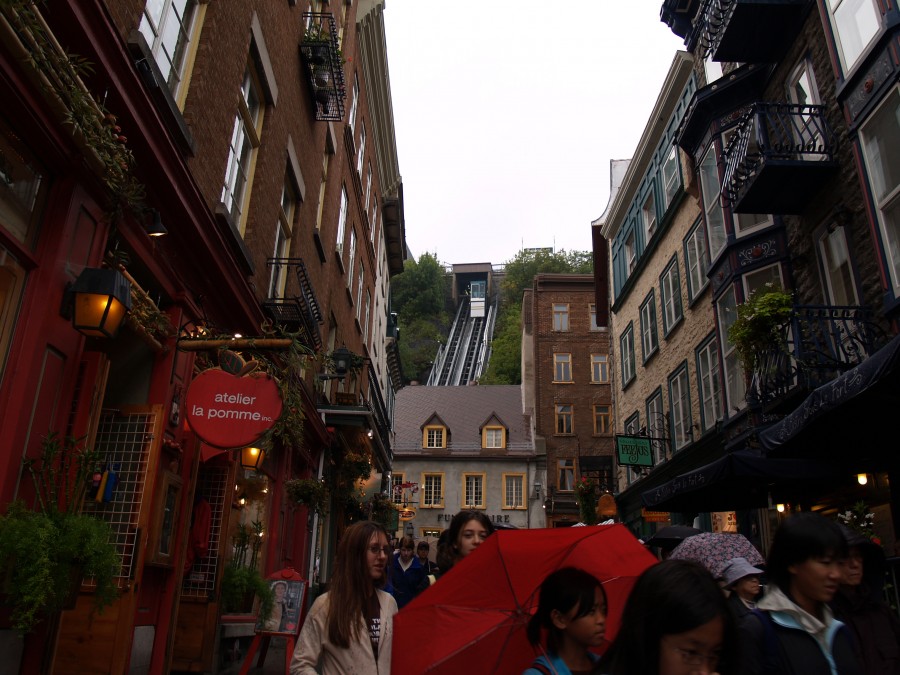
The Old Quebec Funicular is a very short ride that solves a very real Quebec City problem: Upper Town and Lower Town are separated by a steep hill.
You do not need to take it. You can absolutely walk. The question is whether you want to.
What the funicular connects
The upper station is on Dufferin Terrace behind Château Frontenac. The lower station is inside Maison Louis-Jolliet at 16 rue du Petit-Champlain.
That makes it one of the easiest connections between two of the areas almost every first-time visitor wants to see.
Do not expect a ten-minute mountain railway. The ride is brief.
You get an elevated view over Lower Town and the rooftops around Petit-Champlain, which makes the trip more interesting than simply using an elevator. Still, the practical value is the elevation change.
Who should take it?
I would use the funicular without hesitation if someone in the group is tired, has difficulty with steep stairs, is carrying shopping bags or simply wants to save energy for the rest of the day.
It is also useful with children when everyone has reached that point where another staircase is going to create a family discussion no one needs.
If you are reasonably fit and enjoy walking, take the stairs at least once. The routes between Upper and Lower Town are part of the experience, and walking gives you a better feel for the elevation of Old Quebec.
I often think the best answer is to walk one direction and take the funicular the other. That way you get both experiences without turning the hill into a workout contest.
Fare, payment and queues
The fare is charged for a one-way passage and can change. Check the official Funiculaire du Vieux-Québec website for the current price, hours and accepted payment methods instead of building a budget around an old article.
Because both stations sit directly inside the Old Quebec walking circuit, I would treat the funicular as a short connection between attractions rather than a separate destination that needs its own time block.
This is a walk-up attraction rather than an experience that needs to control your itinerary. If the current fare or line does not make sense for your group, the stairs remain close by.
The funicular is small and sits in the middle of two of the busiest tourist areas in the city. In peak summer periods, cruise days and major holiday weekends, a line is not surprising.
If the wait becomes absurd and your group is capable of walking, the stairs may genuinely be faster. Check the queue before committing, particularly if you are trying to reach a timed reservation in Lower Town.
Accessibility
Québec’s official tourism listing describes the funicular as partially accessible, but travelers should confirm their specific needs with the operator before visiting. Historic sites have physical constraints, and policies around mobility devices, strollers and luggage can change.
Do not make assumptions based only on photos of the cabins. The Bonjour Québec listing provides current contact and accessibility information.
In dry summer weather, walking the hill can be enjoyable. In winter, packed snow and ice can make the funicular much more appealing.
That does not mean service is immune to weather or maintenance interruptions, so check current operating information if your itinerary depends on it.
How I would use it
Start in Upper Town, walk Dufferin Terrace, take the funicular down, then explore Petit-Champlain and Place Royale.
Or reverse the route after dinner if you are staying higher up and do not feel like climbing at the end of the night.
The funicular is not a must-do because the ride itself is spectacular. It is useful because Quebec City has hills, and sometimes the smartest travel decision is simply to save your legs.
Discover more from Quebec City 101
Subscribe to get the latest posts sent to your email.