Tabarnak, also written tabernak, is a strong Quebec French swear word derived from tabernacle. It can express anger, surprise, frustration or emphasis. In English, its force can be closer to “fuck!” than the harmless-sounding literal translation “tabernacle.” Context matters.
That is the trap for visitors. You learn a word connected to a church and discover that it is not necessarily something to say in front of your grandmother.
What does tabarnak mean in English?
There is no single translation that works in every sentence. As an exclamation, it can do the work of an English swear after something goes wrong. In other constructions, it adds intensity or becomes an insulting way to refer to somebody.
For an illustrative example, imagine dropping your phone into a puddle and letting out “Tabarnak!” You are expressing frustration, not identifying a religious object. Translating that as “tabernacle!” would preserve the word’s ancestry and lose the entire point.
“Damn!” may fit a particular translation, but it can understate how vulgar the Quebec word sounds. Equally, someone using it playfully among friends is not necessarily furious. The voice, relationship and situation help supply the meaning.
Why a church word became a swear
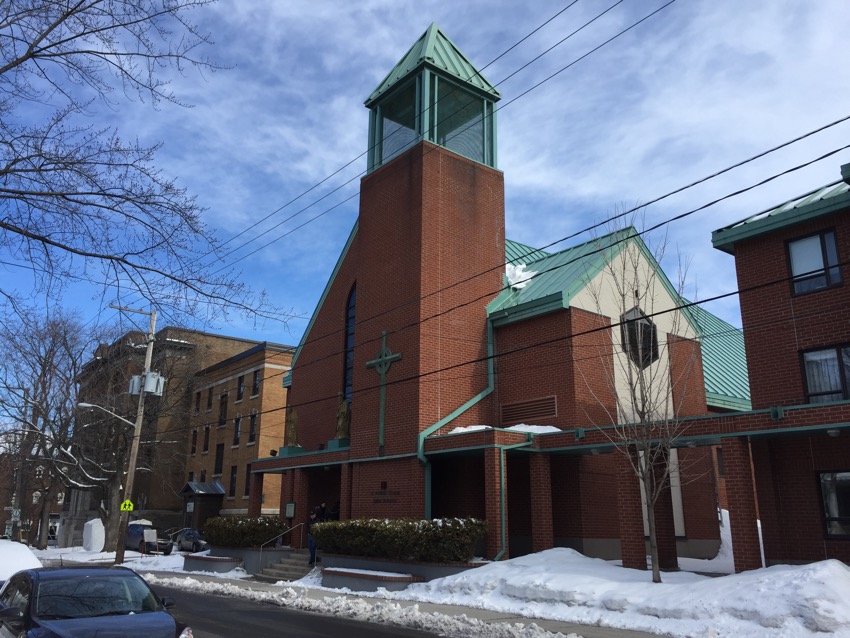
The source word is the French tabernacle: in a Catholic church, the locked cabinet where consecrated communion hosts are kept. Usito’s dictionary entry explains that religious meaning.
Tabarnak belongs to Quebec’s sacres, a group of swear words drawn from religious vocabulary. Other examples include câlisse, from chalice, and osti, from the communion host.
In her explanation of Quebec sacres for Usito, linguist Diane Vincent connects the development of this distinctive vocabulary to the Church’s influence in the nineteenth century. She also explains how changed pronunciations distinguish sacred words from their profane uses.
The religious origin does not mean every speaker is making a statement about religion. A word can outlive the particular taboo that originally gave it its force.
How the word works in conversation
A sacre can stand alone, intensify an expression or join other sacres in a longer string. That flexibility is part of what makes Quebec swearing interesting: the words do more than interrupt an otherwise polite sentence.
En tabarnak can express extreme anger or intensify a description. Compare being very angry with saying something is extremely expensive: the surrounding sentence tells you which job the expression is doing.
Ma prof de français’s lesson on sacres gives spoken examples and explains these grammatical patterns. Listen for the whole expression rather than translating each word separately.
How do you pronounce tabarnak?
A rough English guide is “ta-bar-nak”, with a hard final k. Treat that as an approximation, not a substitute for hearing a Quebec speaker. The French vowels and r will not be captured perfectly by an English spelling.
The swear is usually shorter than the full religious word tabernacle. Do not add an English “-kul” ending when trying to reproduce tabarnak.
Is tabernak the same word?
In this context, yes. You will encounter tabarnak, tabarnac, tabernak and tabernac in writing. They do not represent four separate swear words with four reliable levels of offensiveness.
Our guide to tabernak, tabarnak and the other spellings explains the letters, pronunciation and difference from tabernacle.
When should visitors avoid using it?
I would learn to recognize it before trying to perform it. Language is not a souvenir. A word that gets a laugh in a travel video can land very differently when directed at a stranger.
Work, formal introductions and customer-service exchanges are not where I would experiment. Friends who swear comfortably together have a relationship that a visitor has not automatically acquired.
There are softened forms, including tabarnouche and tabarnane. Those change the word itself; simply swapping the final k for a c does not make it polite.
For the wider vocabulary, see our guide to Quebec French swear words. Understanding what you hear is useful. Demonstrating all of it to the hotel receptionist is optional.
Discover more from Quebec City 101
Subscribe to get the latest posts sent to your email.