Archive notice: Helen McNicoll: An Impressionist Journey was on view at the Musée national des beaux-arts du Québec from June 20, 2024, to January 5, 2025. The temporary exhibition has ended, but its subject remains an important entry point into Canadian Impressionism.
Who was Helen McNicoll?
Helen McNicoll was born in Toronto in 1879 and grew up in Montreal. Deaf from early childhood, she pursued artistic training at the Art Association of Montreal before continuing her studies in London. At a time when many professional and social spaces were restricted for women, travel and art school gave her access to new subjects, colleagues and working methods.
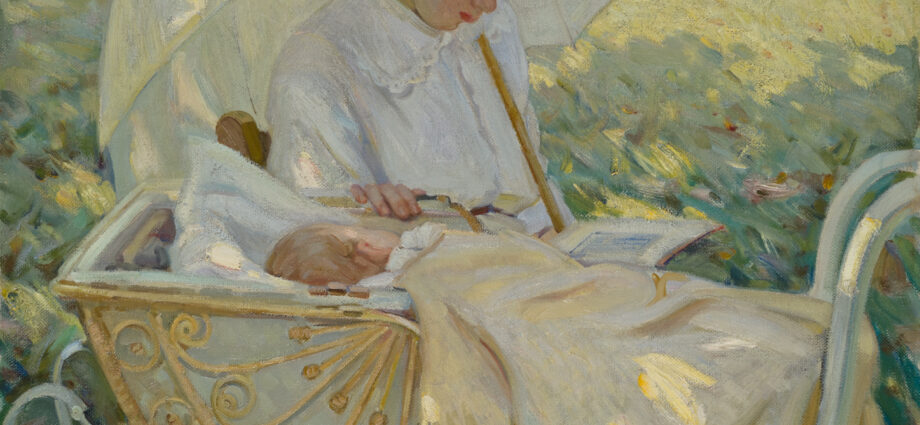
McNicoll became known for luminous scenes of everyday life, landscapes, children and women’s work. She often painted outdoors, using broken brushwork, bright colour and close observation of changing light. Her pictures are associated with Impressionism, but they also document the independence required for a woman artist to travel and work professionally in the early twentieth century.
What the MNBAQ exhibition explored
The retrospective followed McNicoll’s travel and career while examining friendship, freedom and mobility alongside her technique. According to the museum’s official exhibition archive, the show presented more than 65 paintings, including 25 from the Pierre Lassonde collection.
That scale allowed the exhibition to move beyond a few familiar canvases. Visitors could see how McNicoll treated sunlight, domestic work and outdoor leisure across different settings. The curatorial story also placed her within international networks rather than treating Canadian art as isolated from British and European training.
Why the retrospective mattered
The MNBAQ described it as the first Quebec retrospective of McNicoll’s work in a century. Major exhibitions shape which artists enter public memory, so giving a large museum platform to McNicoll helped correct an art-historical imbalance in which several male Canadian Impressionists received more sustained attention.
Her deafness is relevant to her biography, but it should not reduce the work to a story of overcoming disability. The paintings deserve attention for their composition, colour and perspective. The exhibition’s stronger contribution was to consider the full artist—her practice, relationships, mobility and ambition—rather than attaching a single inspirational label.
A short career with a lasting record
McNicoll was elected to the Royal Society of British Artists in 1913 and the Royal Canadian Academy of Arts in 1914. She died in 1915 at age 35 following complications from diabetes. A major retrospective of more than 120 works was held in Montreal ten years later, evidence that her reputation was significant soon after her death even if it later needed rebuilding.
The painting shown in this article’s featured image is À l’ombre de l’arbre, dated around 1915 and held by the MNBAQ. Its shaded figures and sunlit surroundings capture the contrast between rest and brightness that makes McNicoll’s outdoor scenes so immediate.
What visitors can do now
The 2024–25 exhibition cannot be visited now, so do not plan a trip around its old dates. Use the official archive for the historical record and check the museum’s current calendar for exhibitions actually on view. The MNBAQ’s permanent collection and four-pavilion complex still make it a worthwhile stop.
For practical details on tickets, buildings and how the museum fits into a Quebec City itinerary, see our MNBAQ visitor guide. This page remains online as a dated archive of a completed exhibition, not as a current event listing.
For another first-person MNBAQ exhibition archive, read our reflections on Niki de Saint Phalle at MNBAQ.
Discover more from Quebec City 101
Subscribe to get the latest posts sent to your email.