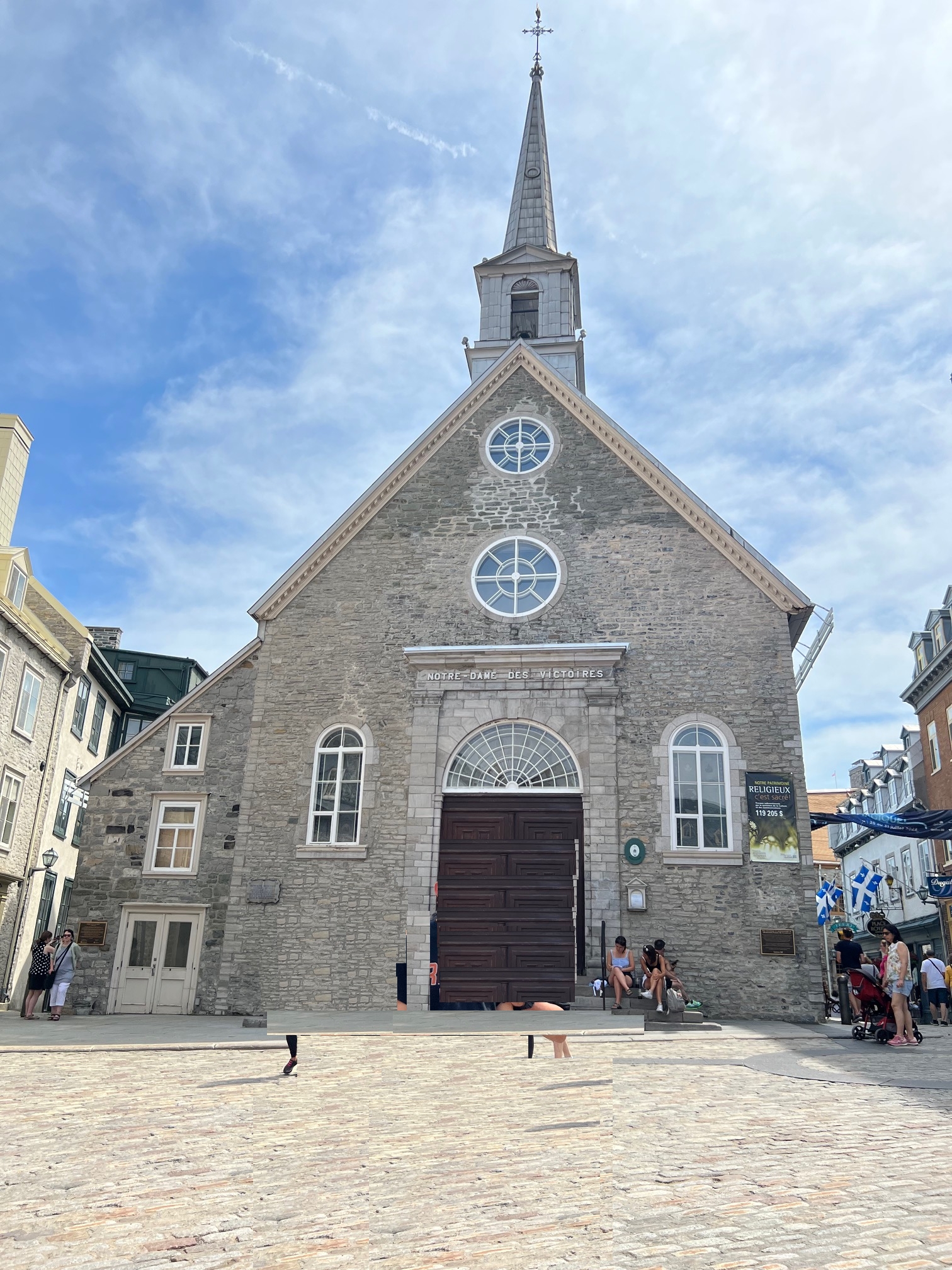
Notre-Dame-des-Victoires is the small stone church that anchors Place Royale in Quebec City’s Lower Town. The square is so visually strong that visitors sometimes photograph the church, turn around and leave without understanding why the building matters.
I would give the church itself 15 to 30 minutes, then spend longer in Place Royale and the surrounding streets.
Why Notre-Dame-des-Victoires matters
Construction began in 1688 on the site associated with Samuel de Champlain’s early settlement. Destination Québec cité identifies it as the oldest stone church in Canada to have retained its original walls.
The church’s name commemorates French victories over English attacks on Quebec in 1690 and 1711. That history makes more sense when you remember how exposed the settlement was and how important control of the St. Lawrence River was to the colony.
The official Destination Québec cité listing for Notre-Dame-des-Victoires is a useful current reference for the site and contact information.
Damage, rebuilding and what remains
The church was heavily damaged during the British bombardment of Quebec in 1759 and later rebuilt. What you see today reflects centuries of worship, destruction, restoration and adaptation rather than one untouched moment from New France.
One detail worth looking for is the tabernacle of the Sainte-Geneviève Chapel, which Destination Québec cité identifies as the only original element remaining.
What to look for inside
The interior is compact, so you do not need an hour. Look at the altar, devotional art and the ship suspended above the nave.
The ship is a replica of Le Brézé. The current tourism listing notes that it was saved from the ruins of the Notre-Dame de Québec Basilica-Cathedral in 1759, giving the object a direct connection to the destruction experienced by the city that year.
Notre-Dame-des-Victoires remains a church rather than a museum set, so if worship or a parish event is underway, keep voices low and treat the space accordingly.
Hours and interior access
Do not assume a small historic church keeps museum-style hours every day of the year. Interior access can vary with the season, services and parish events.
If seeing the inside is essential to your plans, verify access before making a special trip. Even when the doors are closed, the exterior and Place Royale remain worth seeing as part of a Lower Town walk.
Pair the church with Place Royale and Petit-Champlain
I would never come to Lower Town only for this church. The value is the whole setting.
Notre-Dame-des-Victoires sits directly on Place Royale and within an easy walk of Petit-Champlain and the Musée de la civilisation. Spend time in the square before moving on.
Look for the traces of Champlain’s second Habitation marked outside the church. They help connect the building to the much earlier settlement history underneath the present-day square.
Best time to visit
Early morning is excellent if you want photographs with fewer people in the square. Christmas is visually spectacular but much busier, and summer crowds can be heavy in the middle of the day.
This is Lower Town. If you walked down, eventually you have to go back up. The nearby Old Quebec Funicular is the easiest way to avoid another steep climb when the stairs are not appealing.
Accessibility and surfaces
Place Royale has uneven historic surfaces that can be slippery in rain, snow or ice. Visitors with limited mobility should plan the Lower Town portion of the day carefully and verify current church access rather than assuming the historic building will function like a modern attraction.
Is Notre-Dame-des-Victoires worth visiting?
Yes, especially because it asks so little time. You do not need to be religious to appreciate the scale, the surviving stone walls and the way the church gives physical context to the settlement that grew into Quebec City.
Go inside if access is available, then step back outside and look at Place Royale with the church’s history in mind.
Discover more from Quebec City 101
Subscribe to get the latest posts sent to your email.