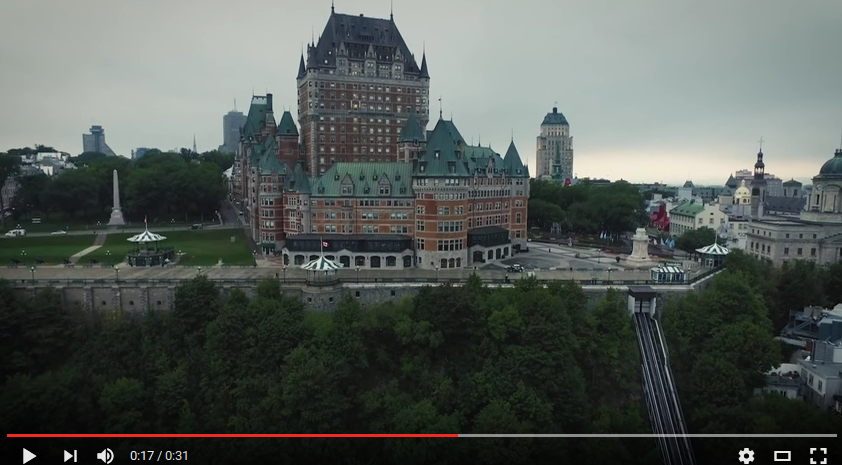
Drone footage makes Quebec City look incredible because the geography becomes obvious from the air: the cliff, the river, the walls, the dense old city and the way everything sits above the St. Lawrence.
Watching aerial footage is easy. Flying your own drone here requires more planning.
What looks best from the air
The obvious subjects are the St. Lawrence River, the Québec–Lévis ferry route, Montmorency Falls, Île d’Orléans and the Old Quebec skyline.
All of them look good from above. That does not mean you are legally allowed to launch a drone wherever you happen to be standing.
A video being online does not prove the flight was legal, permitted or safe. The pilot may have had authorization, the rules may have changed, or the flight may simply have broken them.
Know whether your drone is under or over 250 grams
Canada treats drones with an operating weight under 250 grams as microdrones. Transport Canada says microdrones do not need to be registered and their pilots do not need a drone pilot certificate.
That does not make them rule-free. Microdrone pilots still have to fly safely, stay clear of restricted airspace and emergency sites, respect privacy and trespassing laws, and avoid creating a hazard. The operating weight includes anything attached to or carried by the drone, so an accessory can push a sub-250-gram aircraft into the next category.
For drones weighing 250 grams or more, Transport Canada requires registration and the appropriate pilot certificate. The exact operating category depends on the aircraft, airspace, distance from people and type of operation. Start with the current Transport Canada drone-safety guidance rather than relying on an old travel video or forum post.
Advertised events have a separate rule
Flying at an advertised outdoor event requires special attention. Transport Canada says drones weighing 250 grams or more have required a Special Flight Operations Certificate for this kind of operation since 2019. As of April 1, 2025, that requirement was extended to microdrones under 250 grams as well.
In other words, a small drone is not an automatic loophole at a concert, festival, market or sporting event. If the public event is part of your shot, check the current advertised-event rules before you plan the flight.
Foreign visitors need to check extra requirements
If you are visiting Canada from another country, do not assume your home-country certification transfers automatically.
Transport Canada says foreign pilots flying drones weighing 250 grams or more in Canada need a Canadian drone pilot certificate. Foreign pilots cannot simply register a foreign-owned drone in Canada, so a Foreign SFOC-RPAS may also be required to satisfy registration rules.
Foreign pilots using microdrones under 250 grams generally do not need a Foreign SFOC-RPAS unless they are flying at an advertised event, but the normal microdrone safety rules still apply. If you are bringing a drone across the border, check the current foreign-pilot guidance before the trip.
Check airspace immediately before every flight
Quebec City includes dense pedestrian areas, airports, heliports, controlled airspace, events and sensitive locations. The answer can change by location and by day.
Transport Canada directs pilots to current planning tools including NAV Drone and the National Research Council’s Drone Site Selection Tool. Check the airspace around the exact launch area and review current NOTAMs before you fly.
Do not rely on a screenshot saved weeks earlier. Temporary restrictions, emergency activity and event restrictions can change the answer.
Parks Canada sites in Old Quebec are no-drone zones for recreational use
This matters because some of the most tempting viewpoints are managed by Parks Canada. Parks Canada states that its places are no-drone zones for recreational use unless you have a permit or special permission.
That includes the Fortifications of Québec National Historic Site. Parks Canada also specifically applies the restriction to Dufferin Terrace through the Saint-Louis Forts and Châteaux National Historic Site visitor guidance.
For non-recreational drone filming at the Fortifications, Parks Canada requires a filming request, permission from the Field Unit Superintendent and compliance with Transport Canada requirements. Do not assume that being able to stand on the terrace means you can launch from it.
Ground rules and airspace rules are different
Even when aviation rules allow a flight, the property owner, park, attraction or historic site may prohibit launching or operating a drone from the site.
Old Quebec is packed with pedestrians during much of the tourism season. The most photogenic launch point is not necessarily a safe or legal one.
Before flying from any attraction or privately managed property, check both sides of the question: whether the airspace permits the operation and whether the land manager permits the launch and landing.
Privacy and wildlife still matter
Do not fly low over private homes, patios or people simply because the camera can.
Île d’Orléans is scenic, but it is also home to residents and working farms. Treat it that way.
Drones can also disturb birds and other wildlife. Follow current wildlife and park guidance and back off if your aircraft is changing animal behavior.
A practical pre-flight checklist
- Confirm the drone’s operating weight, including anything attached to it.
- Confirm the pilot certificate and registration requirements that apply to your operation.
- Check the exact airspace in NAV Drone or the NRC Drone Site Selection Tool.
- Review current NOTAMs and look for temporary restrictions or emergency activity.
- Check whether the location is a Parks Canada site, attraction or other property with its own launch rules.
- Check whether an advertised event changes the permissions you need.
- If you are a foreign pilot, verify the current Canadian certificate and SFOC requirements before travelling with the drone.
That sounds like a lot because drone rules are not one single yes-or-no map. Aircraft weight, pilot status, airspace, the ground you launch from and what is happening nearby can all matter.
Ground-based alternatives are easier
You do not actually need a drone to get a broad view of Quebec City.
The Québec–Lévis ferry gives you a wide skyline view from the river without dealing with aviation rules, while Montmorency Falls has elevated viewpoints for dramatic landscape photography.
If you are flying, treat the legal and safety planning as part of the photography. If that sounds like too much work, keep your own camera on the ground and enjoy the aerial footage that already exists.
Discover more from Quebec City 101
Subscribe to get the latest posts sent to your email.