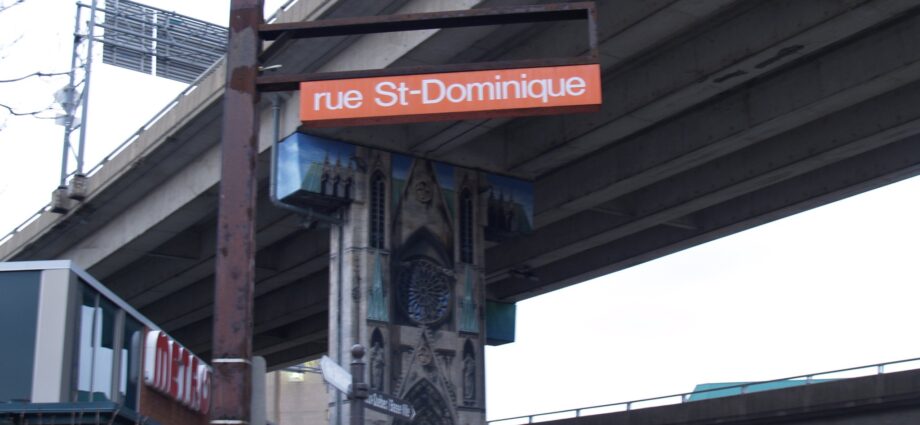
Quebec City Chinatown history is easy to miss because the former district around Saint-Roch and Lower Town was reshaped by redevelopment and urban renewal.
It was never the scale of Montreal, Toronto or Vancouver’s Chinatowns, but Chinese-owned laundries, restaurants and businesses formed a real community presence in and around Saint-Roch and Lower Town.
Where was Quebec City’s Chinatown?
The district was concentrated around parts of the Saint-Roch/Lower Town area rather than defined by one monumental gate or a huge continuous commercial strip.
That makes the history less visually obvious today. The City of Quebec’s multiethnic Saint-Roch history records a Chinese community of about 100 people around 1910 and describes the role of laundries and restaurants.
Chinese immigrants arrived in Canadian cities under difficult legal and social conditions, including exclusionary policies and widespread discrimination.
In Quebec City, laundries and small businesses became some of the visible anchors of the community.
Why laundries appear so often in the history
Discrimination and restricted employment opportunities pushed many Chinese immigrants in Canadian cities toward occupations they could enter with limited capital and fewer formal barriers.
Laundry businesses became part of that pattern.
Urban renewal, road construction and redevelopment reshaped major parts of Saint-Roch and surrounding Lower Town.
Homes and businesses were displaced, street patterns changed and communities that depended on physical proximity were weakened.
The district did not vanish because of one single project or one simple motive.
Demographic change, redevelopment, migration within the city and broader social conditions all played roles.
An earlier version of this article claimed the decisions were purely economic and unrelated to race. That conclusion was stronger than the evidence supported and has been removed.
Why race still matters to the context
Chinese Canadians faced federal discrimination, immigration restrictions and social exclusion across Canada.
That wider context matters even when one specific road project cannot be reduced to a single discriminatory intent.
History becomes inaccurate when we erase either side of that complexity.
Quebec City does not have a formally defined Chinatown today.
You will not find one preserved street that gives you the full story.
The history survives through archival photographs, records, neighborhood history and family stories.
Why this history is easy to miss
Tourism naturally emphasizes the visibly preserved parts of Quebec City: walls, churches and stone buildings.
Communities whose physical landscape was demolished are harder to “see,” which is exactly why they need interpretation.
Walk Rue Saint-Joseph and Saint-Roch with the understanding that the modern neighborhood sits on top of multiple earlier versions of the city.
Compare archival imagery with the roads and buildings you see now.
Calling it a Chinatown is useful, but it can create the wrong expectation of a formally bounded district. The community operated through residents, restaurants, laundries and institutions that extended beyond one block. Its significance comes from those networks, not from having a ceremonial gate.
Population and businesses grew
City and community-history sources trace the Chinese presence in Quebec City to the late nineteenth century. By the mid-twentieth century, the population and network of businesses had expanded substantially. That longer timeline helps correct the idea that the enclave was only a brief roadside cluster.
Archival photographs, directories, oral histories and objects can recover details that the rebuilt streets no longer show. Compare multiple sources and dates: one photograph may document a particular restaurant or laundry, but it cannot represent the entire community or every stage of the neighborhood.
To understand how the historic core differs from the neighborhoods shaped by later redevelopment, continue with our guide to Old Quebec City.
My take
Quebec City’s lost Chinatown is important precisely because so little physical evidence announces it to visitors today.
The story is not simply “there used to be Chinese businesses here.” It is about immigration, exclusion, entrepreneurship and the way urban redevelopment can erase a community from the visible cityscape.
Discover more from Quebec City 101
Subscribe to get the latest posts sent to your email.