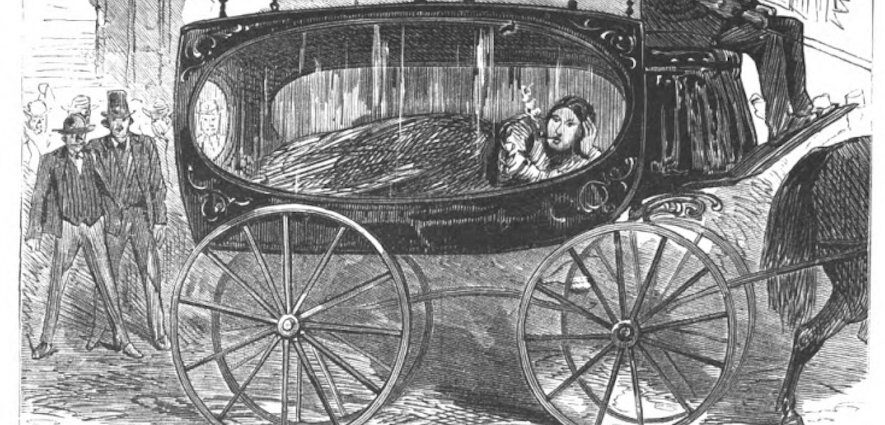
A Quebec woman in a hearse is the subject of one of the strangest stories attached to 19th-century Quebec City. In 1871, the Illustrated Police News claimed that she rode through Saint-Jean Street lying in the hearse and smoking a pipe.
It is a memorable image. It is also not a story we can treat as established fact.
What did the newspaper claim?
‘A Quebec Woman Creates a Sensation, Riding Through St. John Street in a Hearse, Reclining on the Coffin-Bed, and Smoking a Pipe.
What will women do next to distinguish themselves, we wonder! A female in Quebec, the other day, perpetrated a ghastly joke, mocking death in his own domain, by lying down in a hearse and smoking a pipe in a funeral chariot was driven through the street.
If this exhibition had been made in the United States, our neighbours at the North would have made it the subject of very strong animadversions.’
The wording above is preserved because it is the primary artifact behind the story. Its awkward grammar, moralizing tone and fascination with a woman breaking social expectations are part of what the clipping reveals about the publication.
Did the hearse ride really happen?
We have not found independent contemporary Canadian reporting that confirms the episode. That does not prove it was invented, but it leaves the claim unverified. The safest description is therefore “an 1871 newspaper story,” not a documented event from Quebec City history.
The Illustrated Police News built its appeal around sensational crime, scandal and dramatic illustrations. Publications in that tradition often mixed genuine reports with exaggeration, recycled anecdotes and scenes designed to shock readers. An extraordinary claim in a single sensational source deserves caution.
Details that would normally help establish the incident are missing. The woman is not named. There is no precise date, no identified driver, no police record cited and no second newspaper account attached to the claim. Even the exact route is reduced to the broad reference “St. John Street.”
Why the story still matters
An unverified clipping can still be historically useful when it is labeled honestly. It shows what editors believed would sell newspapers: death turned into spectacle, public behavior judged through gender, and a supposedly exotic incident from a distant city.
The story also captures how quickly a short item could turn a real street into a stage for an international audience. Readers who had never visited Quebec City were given a theatrical scene rather than context about rue Saint-Jean, its residents or everyday life.
That distinction matters for local-history writing. Repeating the incident without qualification would convert a colorful allegation into a false certainty. Discarding it entirely would lose a revealing example of Victorian media culture. The responsible middle ground is to preserve the wording, identify the source and make the evidentiary limit clear.
What was rue Saint-Jean like in 1871?
Saint-Jean was already an important commercial street, connecting the old city and neighborhoods beyond the walls. A hearse moving through a busy public corridor would have attracted attention, which makes the absence of readily located corroboration notable but not conclusive.
For a firmly documented piece of rue Saint-Jean history from the same year, see our article on J.A. Moisan, founded in 1871. That surviving business provides the kind of names, dates and physical continuity that the hearse anecdote lacks.
How to read sensational historical clippings
Start by separating what the source actually says from what later retellings add. Then look for names, dates, addresses and other publications that can confirm the event. Consider the outlet’s business model and whether the illustration was documentary or imaginative.
In this case, the strongest conclusion is modest: an American sensational newspaper printed the claim in 1871. The image is fascinating, the story is possible, and independent confirmation remains missing.
For another story about how the city changed over time, read our history of Quebec City’s lost Chinatown.
Discover more from Quebec City 101
Subscribe to get the latest posts sent to your email.