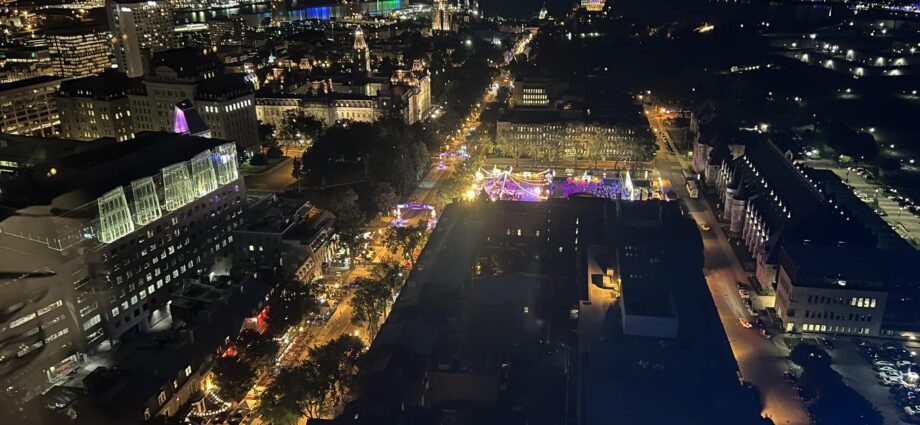
Quebec City itself has substantial light pollution, so serious stargazing is better outside the urban core. The key is not simply finding an empty road: choose a place where nighttime access is permitted, where you can park safely and where nearby lights will not erase your night vision.
Observatoire de la Découverte
The Observatoire de la Découverte hosts astronomy programming and public observation events near Quebec City. Check the current schedule before making the trip because access is tied to organized programming rather than guaranteed nightly admission.
Jacques-Cartier region
Driving north into the Jacques-Cartier region puts more distance between you and the city’s light dome. If you use a park, campground or public recreation area, confirm that the site allows nighttime access rather than assuming a daytime viewpoint stays open after dark.
A campground can be more practical than a roadside pull-off because legal overnight access, parking and washrooms are clearer. Reserve ahead in busy summer and fall periods, and follow quiet-hour and lighting rules.
Stoneham and Tewkesbury
These areas are closer to Quebec City and can offer darker skies than downtown, especially when you find a legal public location away from direct lighting. They are useful when you do not want a long drive, but mountain weather and cloud can change quickly.
For a true dark-sky trip
Mont-Mégantic is much farther from Quebec City, so it is not a casual evening detour. It is the province’s benchmark astronomy destination and sits in an International Dark Sky Reserve. The ASTROLab offers scheduled astronomy evenings and telescope activities; use its current calendar and reservation instructions rather than arriving unannounced.
Choose the night before the location
Cloud cover matters more than a famous viewpoint. Check an hourly forecast, humidity and wildfire-smoke conditions before driving. A bright moon can be excellent for photographing a landscape but poor for faint stars and the Milky Way. Plan meteor-shower viewing for the hours when the radiant is higher and give your eyes time to adapt.
What to bring
- Warm layers, even in summer
- A red-light flashlight or a dim red phone setting
- A chair or insulated ground pad
- Water and a fully charged phone
- A paper or offline map for weak-signal areas
- Insect protection in warm months
Use white light only when safety requires it, and never point a bright lamp toward other observers. If you photograph the sky, stabilize the camera on a tripod and start with a wide lens rather than buying a telescope for one trip.
Best time of year
Summer offers milder temperatures but also shorter nights, insects and haze. Autumn brings longer darkness and often clearer air, though temperatures fall quickly after sunset. Winter can produce excellent transparency, but cold becomes a safety issue and equipment batteries drain faster. Spring conditions are variable, with wet ground and lingering snow outside the city.
For a first outing, choose a clear, moon-aware night at an organized site rather than chasing a rare astronomical event. A comfortable two-hour session under reasonably dark skies is more useful than an ambitious trip abandoned because access or weather was misunderstood.
Safety and access
Do not stop on a highway shoulder, enter private land or cross a locked gate for darker skies. Tell someone where you are going, watch for wildlife and drive slowly on unfamiliar rural roads. Winter outings require a realistic plan for cold, snow, battery life and roadside emergencies.
For the Perseids or organized astronomy events, check Destination Québec cité’s event calendar and the venue before driving out. For more daytime and evening ideas beyond downtown, browse our outdoor activities near Quebec City and Jacques-Cartier National Park guide.
Discover more from Quebec City 101
Subscribe to get the latest posts sent to your email.