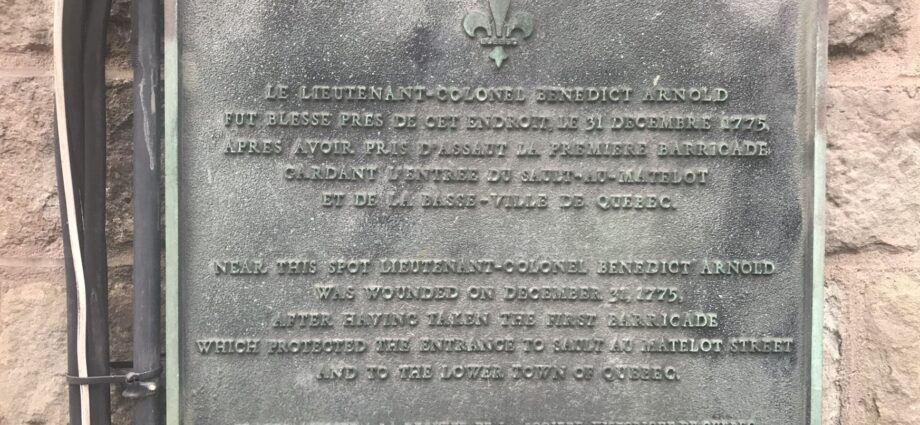
Benedict Arnold’s Quebec City story begins before his betrayal, with the exhausting 1775 expedition and the failed December 31 attack on the fortified city.
The Quebec campaign is a good reminder that history is much messier when you stop reading it backward from the ending everybody knows.
Why did the Americans invade Quebec?
Early in the American Revolution, Continental forces hoped British-held Quebec might be brought into the rebellion or at least removed as a base for British military operations.
The campaign developed from more than one direction.
Arnold led roughly 1,100 men through the wilderness of present-day Maine toward the St. Lawrence.
The route was brutally difficult.
Maps were poor, food spoiled or ran out, boats were damaged and cold weather turned the march into a survival problem.
Men turned back, became sick or were no longer fit to continue.
By the time Arnold reached the St. Lawrence, the expedition had already paid a huge price without fighting the main battle.
Richard Montgomery approached from another direction
General Richard Montgomery moved toward Quebec after American forces captured Montreal.
He and Arnold ultimately combined their forces outside Quebec City late in 1775.
The Americans attacked Quebec during a snowstorm on December 31, 1775.
The plan involved separate columns moving into Lower Town.
Bad weather may have provided surprise, but it also made an already difficult urban assault even harder.
Montgomery was killed early in the attack.
His column collapsed, removing one part of the coordinated assault.
Arnold was wounded
Arnold was shot in the leg and had to leave the immediate fighting.
His men continued under other officers but eventually became trapped and many were captured.
The failed assault left the Americans unable to seize Quebec City.
That did not mean the campaign ended immediately.
American forces maintained a loose blockade and siege for months.
Disease, expiring enlistments and difficult conditions weakened the remaining army.
British reinforcements changed the situation
British ships and reinforcements arrived in early May 1776.
The Americans were forced to withdraw, effectively ending the attempt to hold Quebec.
The cliffs, fortified Upper Town and narrow approaches to Lower Town made the city difficult to attack.
If you walk the fortifications today, the military logic becomes easier to understand than it is on a flat map.
This is the part people forget.
Arnold continued fighting for the United States for several years after Quebec.
His secret negotiations with the British and attempted surrender of West Point came in 1780.
Why the Quebec campaign matters
It shows Arnold before the betrayal, when he was willing to lead one of the most punishing expeditions of the Revolution.
It also shows why Quebec City was strategically difficult to capture.
For the broader political context, see why Canada remained separate from the United States.
The Fortifications of Québec and Lower Town make much more sense when you know an army once tried to fight through this terrain in a snowstorm.
The defeat ended the best American chance to take Quebec City early in the Revolution. The long withdrawal also showed how distance, weather, disease and supply could defeat an army before any decisive battlefield victory.
You can still read the battlefield geography on foot with our guide to the fortifications of Quebec City.
My take
Benedict Arnold’s Quebec story is more interesting because we already know what he becomes later.
In 1775, nobody standing in the snow outside Quebec City knew him as America’s most famous traitor.
Where to understand the battle on the ground
The easiest way to make the 1775 attack less abstract is to walk between the fortified Upper Town and Lower Town. Parks Canada notes that the December 31 assault came through Lower Town and that the fortifications helped the defenders hold out until British reinforcements arrived in early May 1776.
Walking the walls, the slopes and the narrow Lower Town approaches makes the basic military problem visible: the Americans were trying to attack a defended city through difficult terrain in winter. You do not need to reconstruct every troop movement to understand why Quebec City was such a hard target.
Discover more from Quebec City 101
Subscribe to get the latest posts sent to your email.