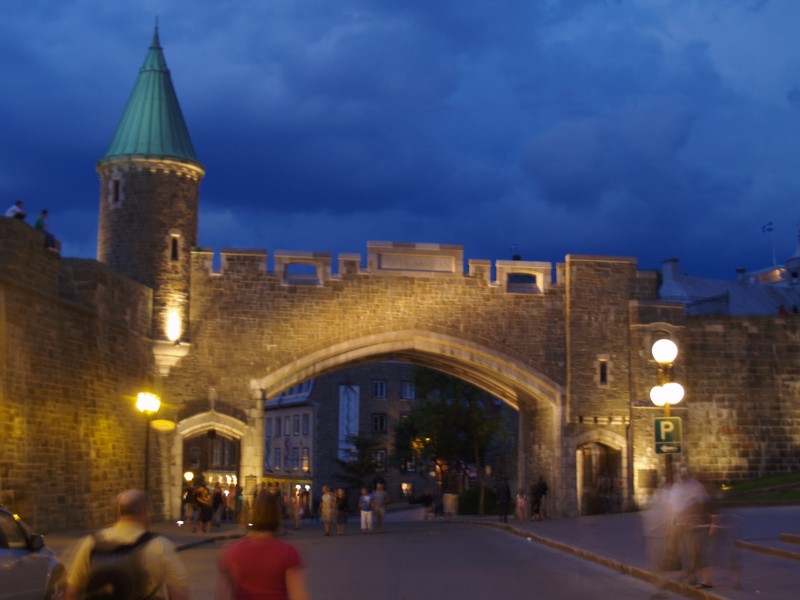
The walls are one of the easiest Quebec City attractions to underestimate because they do not require a ticket, a reservation or a big entrance sign. They are simply part of the city.
That is exactly why I think visitors should make time for them. You do not have to “visit” the fortifications as a separate attraction. You can use them to connect other places and understand how Old Quebec was built.
Why the walls are unusual
Quebec City’s fortifications include surviving ramparts, gates, bastions and defensive works developed over centuries under French and British rule. Parks Canada dates the broader defensive system from 1608 through 1871.
The historic district’s preserved fortifications are a major reason Old Quebec is recognized by UNESCO. You are not looking at a reconstructed theme-park wall. The defensive landscape is woven into the functioning city.
For a first visit, the easiest introduction is around the major gates. Porte Saint-Louis connects naturally with Parliament Hill and Grande Allée. Porte Saint-Jean puts you near Place D’Youville and rue Saint-Jean.
You can see the stonework, walk nearby sections and then continue directly into Old Quebec. There is no reason to make this complicated.
Parks Canada says the fortifications extend about 4.6 kilometres and are accessible year-round, with multiple access points. If you want interpretation rather than a self-guided walk, start at Artillery Park or check the Frontenac kiosk on Dufferin Terrace; guided access and seasonal facilities follow their own schedules and fees. That distinction matters: walking the walls can be spontaneous, while specific historic interiors or tours need planning.
Walk instead of just taking a photo
A lot of people stand at a gate, take one picture and consider the walls “done.” I think that misses the point.
Walk a section. Once you move along the fortifications, you begin to see how the gates, elevation and streets fit together. The city starts making more sense geographically.
The Citadelle of Quebec is a major part of the defensive system, but it remains an active military base. You need a guided tour to enter the Citadelle itself.
The public wall sections are much easier. You can explore them on your own schedule and use them as part of a larger walking route.
How long do you need?
You can get a basic feel for the walls in 30 minutes, or you can spend a couple of hours connecting gates, viewpoints and nearby historic streets.
If this is your first day in Quebec City, I would not obsess over completing every metre. Use the fortifications to orient yourself, then return to sections naturally as you move around Upper Town.
Morning is quieter and gives you room to stop without constantly moving around groups. Late afternoon can be beautiful when the light hits the stone and surrounding rooftops.
Winter is a completely different experience. Snow can make the walls look incredible, but ice and packed snow also make footwear much more important.
Accessibility and walking difficulty
Parts of the route involve slopes, stairs and historic surfaces. If someone in your group has mobility limitations, do not assume every segment will be equally easy.
You can still see major gates and portions of the fortifications without attempting a complete walk. A shorter gate-to-gate route can still explain the basic layout.
The fortifications work naturally with Parliament Hill, Place D’Youville, the Citadelle, Dufferin Terrace and the streets of Upper Town.
My preferred approach is to think of the walls as part of the route rather than another checkbox. Quebec City rewards walking because so many of its attractions overlap physically.
Why they matter beyond the photo
The walls are not merely decorative leftovers. They explain why Quebec City looks and feels different from most other North American cities.
Once you understand the fortifications, the narrow streets, gates and position above the St. Lawrence stop feeling accidental. They are part of the same story.
Discover more from Quebec City 101
Subscribe to get the latest posts sent to your email.