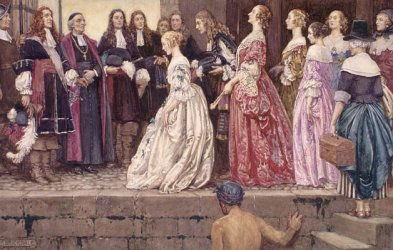
The Filles du Roi—King’s Daughters—are one of the most important population stories in the history of New France, but the nickname creates confusion immediately.
They were not the king’s biological daughters.
They were approximately 800 young women who came to New France between 1663 and 1673 with financial support connected to the French Crown.
Why were they sent to New France?
The colony had a major demographic problem: far more men than women.
France wanted permanent settlement, families and population growth rather than a colony dominated by temporary male workers and soldiers.
Supporting the migration of marriageable women was one part of that strategy.
They came from different backgrounds, although many had modest financial circumstances.
Some were orphans. Some had living families. Their ages, literacy, origins and previous life experiences varied.
Any story that describes them as one identical group is simplifying hundreds of individual lives.
What did the Crown provide?
The French Crown generally supported transportation and settlement costs, and some women received a royal dowry associated with marriage.
The details varied, which is another reason to be cautious about treating one woman’s experience as universal.
The women were expected to marry and contribute to family settlement, but historical records show that they could evaluate potential husbands and that marriage contracts could be negotiated or broken before the wedding.
That does not mean life was easy or that power was equal by modern standards.
It means the simplistic story of women being shipped over and assigned husbands is not accurate.
The Atlantic crossing was serious
Crossing the Atlantic in the 17th century involved disease, cramped conditions, weather and real danger.
Once in New France, the women faced harsh winters, childbirth risks and the challenges of building households in a young colony.
Many French Canadians can trace ancestry to one or more Filles du Roi.
Their relatively small number combined with large families and generations of descendants gave them an enormous demographic legacy.
If your family tree claims descent from a Fille du Roi, do not stop at somebody else’s online tree.
Use parish registers, marriage contracts and reputable genealogical databases to verify each generation.
One incorrect link in the 1800s can create an impressive but fictional 17th-century ancestor.
Use named historical records
The number, dates and individual biographies should come from documented historical and genealogical research, not family legend. The Canadian Encyclopedia overview of the Filles du Roi is a useful secondary starting point, while original parish and notarial records are stronger evidence for a specific ancestor.
Record variant spellings, dates, parishes and spouses as you work. A shared name is not enough to prove that two records describe the same person.
Old Quebec, churches and institutions interpreting New France provide context for the society these women entered.
The Notre-Dame de Québec Basilica-Cathedral is one useful stop because parish and religious life were central to the colony.
Avoid the romantic version
The Filles du Roi story often gets turned into a romantic tale about brave young women finding husbands in a new world.
There was courage, certainly. There was also state policy, demographic strategy, hard labor, risk and limited options.
The real history is more interesting than the cleaned-up legend.
When possible, use a woman’s name, parish and documented choices instead of discussing the entire group only as a demographic program. The policy matters, but so do the people inside it.
To connect this story with the fortified city the colony became, continue with our guide to Quebec City’s walls.
My take
The Filles du Roi matter because they help explain how New France became a settled society rather than just a trading outpost.
Look at them as individuals whose choices and hardships collectively changed the demographic future of Quebec.
Discover more from Quebec City 101
Subscribe to get the latest posts sent to your email.