Movies filmed in Quebec City benefit from a setting that looks like a film set even when nobody is filming.
Stone streets, surviving fortifications, steep elevation changes, Château Frontenac and the St. Lawrence River give productions a lot of visual range in a compact area. Nearby countryside and villages add another layer without sending a crew hundreds of kilometres away.
The useful way to approach this as a visitor is not to chase every vague online claim. Start with productions whose Quebec City locations are actually documented, then build those stops into a normal sightseeing day.
Why filmmakers like Old Quebec
The historic district gives productions something expensive to build from scratch: real scale.
You can frame narrow streets, stone buildings, gates, squares and older architecture without every shot exposing modern glass towers in the background. That makes Old Quebec useful for stories set in Canada, Europe or fictional places that need a historic look.
Château Frontenac is visually dominant enough that one establishing shot can tell viewers exactly where they are. Cap Diamant and the St. Lawrence River also give the city a dramatic profile that works especially well in wide shots.
If you want to understand the geography before looking for movie locations, our Old Quebec City guide is the better starting point.
I Confess is the classic Quebec City movie
Alfred Hitchcock’s I Confess is the clearest film-location starting point because Quebec City’s official tourism guide says the 1953 movie was filmed entirely in Quebec City.
Documented locations include Château Frontenac, streets in Old Quebec, Le Capitole, the Limoilou neighbourhood and Île d’Orléans. That gives you a real citywide connection rather than one quick establishing shot.
Château Frontenac remains the easiest location for most visitors to recognize. The city’s official tourism site also specifically notes the hotel’s use in the film.
You do not need to recreate every camera angle for the connection to work. Walk Dufferin Terrace, look back toward the Château and continue through Old Quebec. The scale and elevation make it obvious why Hitchcock used the city so heavily.
Catch Me If You Can used Quebec City as Europe
Steven Spielberg’s Catch Me If You Can is another strong example because the city’s official tourism guide identifies specific Quebec-area locations.
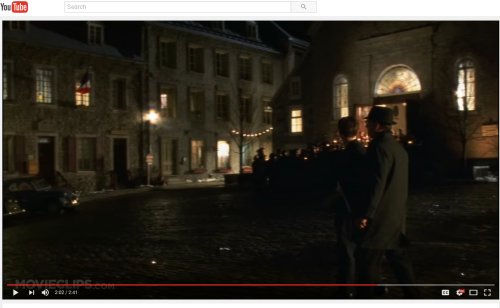
The arrest sequence near the end of the film uses Place Royale and Notre-Dame-des-Victoires Church to stand in for a village in northern France. Additional filming took place in Stoneham-Tewkesbury.
This is exactly the kind of transformation Quebec City does well on screen: the architecture is recognizable to locals, but a production can frame it as somewhere else entirely.
If you are already walking through Petit-Champlain and Place Royale, this is an easy film stop to add without creating a separate itinerary.
Blizzard used Place Royale for a Christmas setting
The 2003 family film Blizzard also used Place Royale. Quebec City’s official tourism guide describes the square as the film’s fairy-tale Christmas setting.
That makes sense visually. Place Royale is compact, historic and especially cinematic when seasonal decorations and winter weather are part of the frame.
The point is not that every Christmas movie in Quebec was shot there. It is that Place Royale is one of the city’s most repeatedly useful screen locations because a crew can get a strong historic look without building an entire street.
Winter changes the city on camera
Snow is another reason productions come here.
A winter street in Old Quebec can look completely different from the same street in July. Snow, early darkness and warm interior lighting can turn familiar streets into a much more stylized backdrop.
Of course, winter production also means cold, snow management and shorter daylight, so the beauty comes with logistics.
Nearby landscapes expand the options quickly. Île d’Orléans gives productions rural roads and farmland. Montmorency Falls adds dramatic natural scenery. Forests, river locations and ski-country landscapes are all within practical reach of the city.
Do not trust every online filming-location list
This is where things get messy.
Some lists include movies set in Quebec City but filmed somewhere else. Others take one exterior shot or a small second-unit sequence and describe the entire production as “filmed in Quebec City.”
For a more reliable starting point, use the official Visit Québec City list of movies and TV shows shot in the city. It identifies productions and, for many of them, specific locations.
If a particular movie matters to you, verify it through official production notes, film commission information, municipal filming notices, archival newspaper coverage or a reliable location record. Then compare the scene with the modern street because façades, signs and interiors change.
A movie may also combine an exterior from Quebec City with an interior filmed somewhere else, so matching one recognizable building does not prove the whole sequence was shot there.
A simple self-guided movie-location walk
Start at Château Frontenac and Dufferin Terrace, where the I Confess connection is the strongest and the cityscape does most of the work for you.
From there, walk downhill toward Place Royale and Petit-Champlain. Place Royale gives you the strongest documented connection to Catch Me If You Can and Blizzard.
Then loop back through Old Quebec rather than chasing distant one-off locations. The city walls and fortifications add another visual layer if you are interested in period settings and the city’s built environment.
If one specific film is the reason for the walk, save screenshots of confirmed scenes before you leave. It is much easier to compare architecture on-site than to search for the exact frame while standing in the cold or blocking a sidewalk.
Respect active film sets
If you happen to find a production filming during your visit, do not assume the crew wants spectators wandering into the frame.
Follow closures, stay behind barriers and let people work. A working set is not a tourist attraction just because it happens to be on a public street.
Film locations work best as a layer on top of a normal sightseeing day, not as a scavenger hunt that forces you across the region for uncertain matches.
My take
The fun of film-location travel in Quebec City is not collecting exact doorways from every movie.
It is seeing why filmmakers keep choosing the city in the first place.
Start with confirmed examples like I Confess, Catch Me If You Can and Blizzard, then look at the streets around you as a production designer might. The architecture starts looking less like a tourist backdrop and more like production design that happens to be real.
Discover more from Quebec City 101
Subscribe to get the latest posts sent to your email.