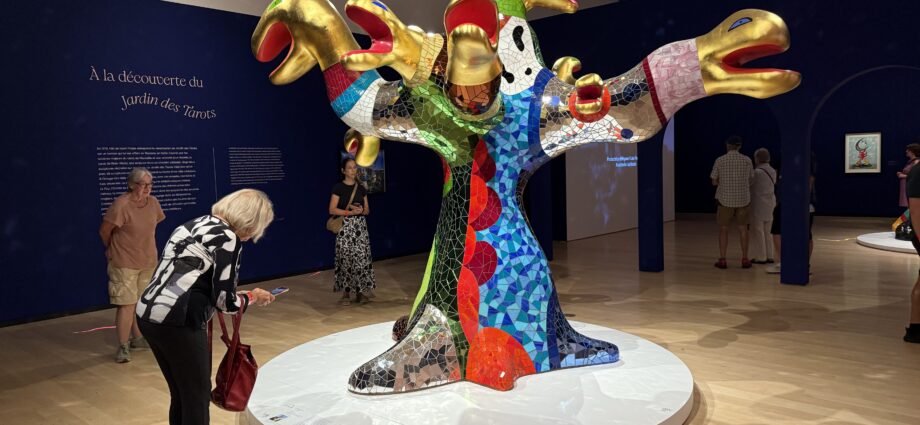
Archive notice: Niki de Saint Phalle: The 1980s and 1990s — Art Unleashed ran at the Musée national des beaux-arts du Québec from June 12, 2025 to January 4, 2026. The exhibition has ended, but this page preserves what it felt like to encounter the artist’s late work in person.
My first reaction
I enjoyed the exhibition because it challenged my assumptions about what museum art is supposed to look like. Some pieces initially struck me as chaotic, playful or almost craft-like rather than solemn and “precise.” That reaction became part of the experience instead of something the show asked me to hide.
Bright colours, mirrored surfaces and exuberant figures can be easy to dismiss as decoration. The longer I stayed, the less useful that dismissal became. Saint Phalle’s work made room for delight while still asking serious questions about power, bodies and public space.
The late work was the point
MNBAQ focused on the last two decades of Saint Phalle’s career, beginning around the period when she launched the monumental Tarot Garden in Italy. The exhibition included more than 150 works across nine sections, giving the later practice enough space to stand on its own rather than appear as an epilogue.
The Tarot Garden mattered as more than background biography. It showed Saint Phalle moving beyond individual objects toward an environment people could enter. Sculpture, architecture, mosaics and landscape met in a project that occupied years of her life and shaped the scale of what followed.
Joy with political and social weight
The playful forms were not separate from serious subjects. MNBAQ framed the late work around women’s rights, opposition to racism, early support for people with AIDS, and concern for animals and the environment. Her illustrated AIDS education work is an especially clear example of using accessible imagery to communicate when fear and stigma were widespread.
That context changed how I read the surfaces. Humour and decoration were not escapes from the world; they were ways of making difficult ideas visible and approachable. Accessibility did not mean shallowness.
Temperance in the Grand Hall
One of the most memorable works for me was the monumental Angel of Temperance in the Pierre Lassonde Pavilion’s Grand Hall. Its scale, wings and colour made it difficult to pass without stopping. The open architecture gave the sculpture room to operate as a public presence rather than a precious object tucked into a small gallery.
Seeing a work at that size also defeats the neatness of a screen. Photographs communicate shape and colour, but not the physical effort of looking up, moving around and noticing how a sculpture changes against glass, people and the building.
Why the exhibition stayed with me
The show made a strong case that decorative materials, visual joy and humour do not make art unserious. For me, the tension between playful surfaces and heavier ideas was what made the visit memorable. I left more willing to question the hierarchy that places restraint above exuberance.
This exhibition is over. Check MNBAQ’s current exhibition calendar rather than travelling specifically for the Saint Phalle show. For practical museum context and other archives, browse our Quebec City museum guides.
For another Canadian Impressionist exhibition archive at the museum, read about Helen McNicoll at MNBAQ.
Discover more from Quebec City 101
Subscribe to get the latest posts sent to your email.