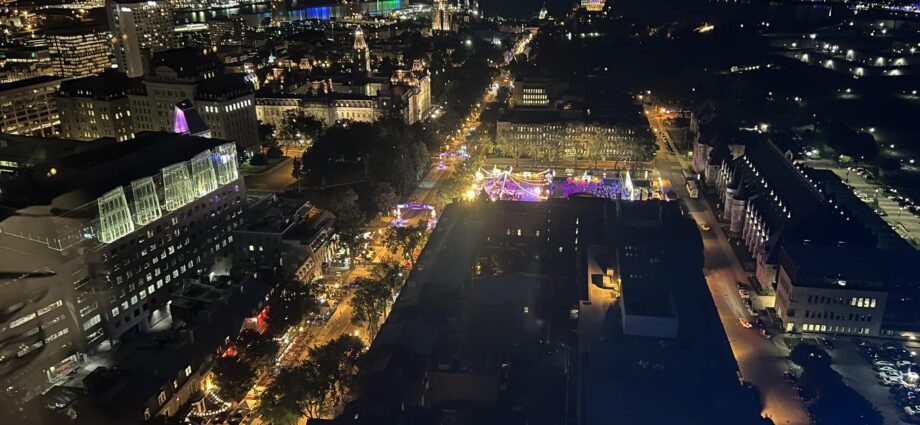
Old Quebec hotels span Upper Town inside and around the walls and Lower Town toward the Old Port and Petit-Champlain. The best choice depends less on a universal ranking than on which streets, hills and services you want outside your door.
Fairmont Le Château Frontenac
Fairmont Le Château Frontenac is the obvious choice when history, river views and a full-service luxury property matter more than budget. The hotel sits beside Dufferin Terrace at the highest-profile address in the district.
The scale brings advantages: multiple dining options, extensive services and a landmark setting. It also means a busier atmosphere than a small inn. Compare room categories carefully because view, size and renovation style vary, and do not assume every room has the postcard perspective seen in promotional photographs.
Auberge Place d’Armes
Auberge Place d’Armes is a small property close to Château Frontenac at the corner of two pedestrian streets. Its central position works well for visitors who want Upper Town restaurants, the Basilica, City Hall and Dufferin Terrace within minutes.
Historic buildings produce rooms with more variation than a standardized modern hotel. Check the exact room description, stairs or elevator access, and street-facing noise considerations before booking. The location is excellent, but central pedestrian streets can be lively.
Hôtel Clarendon
Hôtel Clarendon, across from City Hall, opened in 1870 and combines a long history with a practical Upper Town location. Rue Saint-Jean, the Basilica and Château Frontenac are all nearby.
This is a useful middle ground for travelers who want a recognizable full-service hotel without staying in the Château. As with any historic property, compare renovated room types and current amenities instead of assuming every photograph represents every room.
Monsieur Jean
Monsieur Jean is near rue Saint-Jean inside the historic core. The hotel has a contemporary boutique identity rather than trying to recreate a 19th-century inn.
Choose it when design, modern interiors and Upper Town walkability are priorities. Its position near the edge of the busiest historic streets can also make arrivals simpler than a hotel deeper in a pedestrian-heavy section, although parking and access should still be confirmed directly.
Auberge Saint-Antoine
In the Old Port, Auberge Saint-Antoine is a luxury hotel built around archaeological artifacts found on its historic site. It is close to the Musée de la civilisation, Place Royale and the riverfront.
The archaeological displays give the property a specific sense of place rather than generic luxury styling. Lower Town is convenient for Petit-Champlain and the Old Port, but reaching Upper Town involves stairs, hills or the funicular. Check the hotel’s current notices when booking because preservation and construction work can affect facilities.
Hôtel 71
Hôtel 71 is also in Lower Town, in a former bank building near the Old Port. It combines contemporary interiors with easy access to the riverfront, Musée de la civilisation and Place Royale.
This is a strong choice for travelers who prefer the quieter evening feel of the Old Port to the busiest Upper Town streets. The tradeoff is the climb to Dufferin Terrace, the fortifications and Parliament Hill.
Which historic hotels in Quebec City stand out?
If you are searching specifically for a historic hotel in Quebec City, Château Frontenac and Hôtel Clarendon are the clearest examples on this list. Fairmont Le Château Frontenac opened in 1893 and became the city’s landmark railway hotel, while Hôtel Clarendon dates to 1870.
Auberge Saint-Antoine offers a different kind of historic experience: the property integrates archaeological artifacts recovered from its Old Port site into the hotel itself. The right choice depends on whether you want grand landmark architecture, a longstanding Upper Town hotel or a more intimate property built around the archaeology of Lower Town.
Upper Town or Lower Town?
Choose Upper Town for immediate access to Dufferin Terrace, the city walls, rue Saint-Jean and Parliament Hill. Choose Lower Town for Petit-Champlain, Place Royale, the Old Port and Musée de la civilisation. The funicular can save a steep climb, but its hours and any closure matter when mobility is a concern.
Before booking, compare the total price after taxes and parking, the cancellation policy, air conditioning, elevator access and the exact bed configuration. Verify current construction notices and amenities directly with the hotel. A beautiful lobby cannot compensate for a room or location that does not fit how you travel.
If the landmark hotel is on your shortlist, read why the Château Frontenac photography claim needs context.
Before choosing a property, use our Old Quebec guide to compare Upper Town, Lower Town, hills and walking routes.
Discover more from Quebec City 101
Subscribe to get the latest posts sent to your email.