Quebec City must-sees for a first trip should explain the city’s history, geography and atmosphere without turning the visit into a checklist marathon.
These six stops do that. Five fit naturally into the Old Quebec core, and the sixth—Montmorency Falls—works best as a separate half-day or carefully timed side trip.
If you have only one full day, do not try to “complete” Quebec City. Use these places to understand how Upper Town, Lower Town, the fortifications and the St. Lawrence River fit together.
1. Château Frontenac and Dufferin Terrace
You do not need to stay at Fairmont Le Château Frontenac to appreciate Quebec City’s most recognizable skyline.
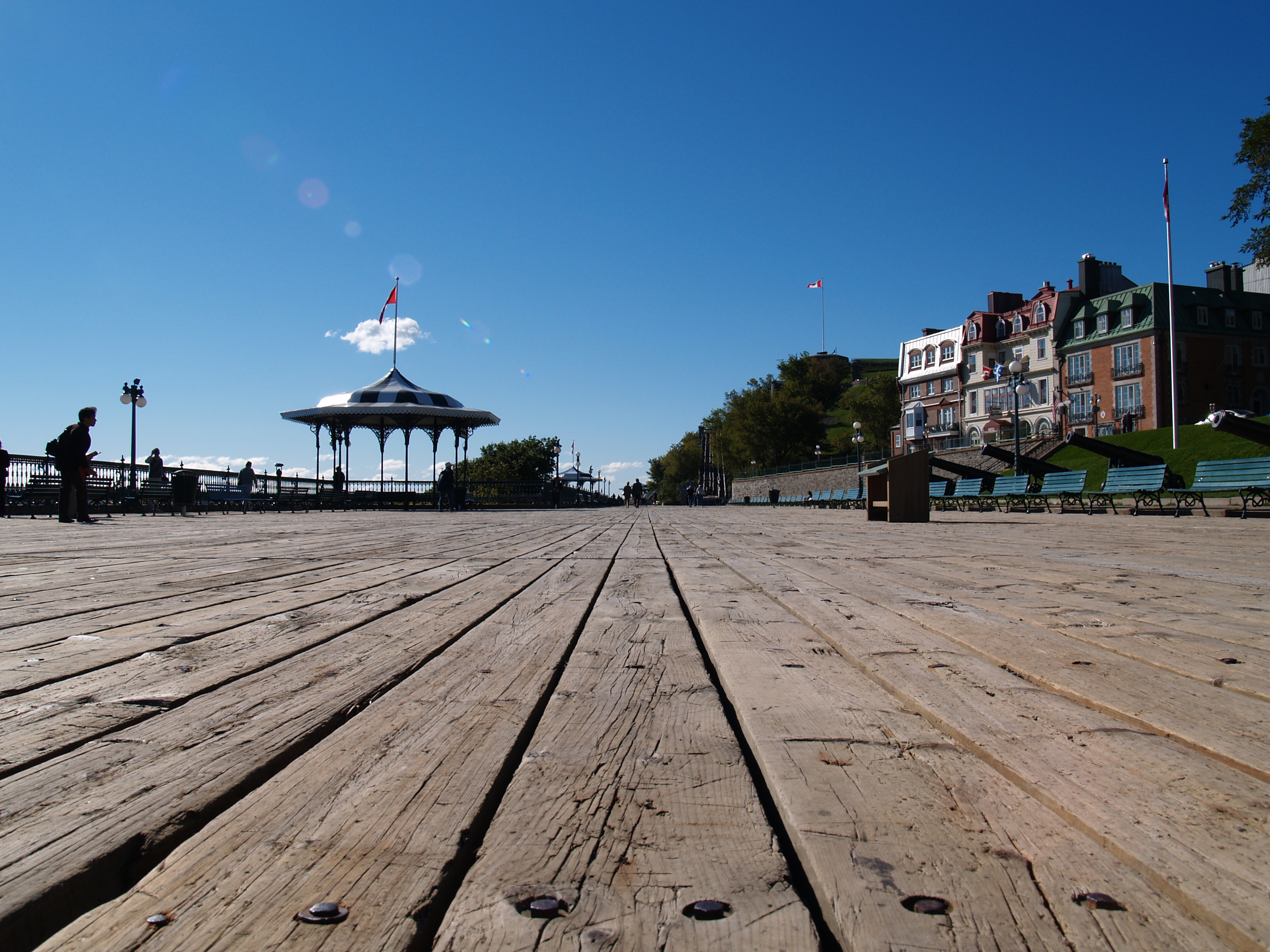
Walk Dufferin Terrace for broad views of the St. Lawrence River, Lévis and Lower Town. Québec City’s official tourism guide describes the terrace as a year-round public promenade and one of the city’s essential viewpoints.
The hotel opened in 1893 and grew through later expansions. Its “most photographed hotel” nickname is impossible to prove, but the location explains why the claim endures. Our guide to Château Frontenac’s history and famous nickname separates the documented facts from the slogan.
This is also where I would orient myself on a first visit. Look down toward Petit-Champlain and the river before you start walking; Quebec City’s steep geography makes much more sense once you see it from the terrace.
2. Petit-Champlain and Lower Town
Walk the narrow lanes of Petit-Champlain, then continue toward Place Royale and the Old Port.
It is one of the busiest visitor areas in the city, but that does not make it disposable. The trick is timing. Early morning, evening and shoulder season give you more room to notice the architecture rather than only the crowd.
The Breakneck Stairs and Old Quebec Funicular connect Lower Town with Dufferin Terrace. Walking down and taking the funicular back up is a practical compromise if the steep climb is difficult.
Leave time to look beyond the main shopping street. The surrounding lanes show how tightly the historic district fits between Cap Diamant and the St. Lawrence River.
3. Place Royale
Place Royale is near the site where Samuel de Champlain established the Habitation de Québec in 1608.
Notre-Dame-des-Victoires Church and the surrounding stone buildings make the square one of the clearest places to connect today’s city with its New France history. Québec City’s official tourism guide continues to identify Place Royale as a foundational site for the city.
The square itself is compact, so combine it with Petit-Champlain rather than treating it as a separate expedition.
If you want more historical depth after the outdoor walk, the nearby Musée de la civilisation can turn Lower Town into a half-day rather than a quick photo stop.
4. The fortifications and city gates
The fortifications are not decorative background. They are central to why Old Quebec is internationally significant.
UNESCO describes the Historic District of Old Québec as an exceptional and well-preserved fortified colonial town. The district includes the Upper Town ramparts, gates, Citadelle and Lower Town around Place Royale.
Walk at least part of the Quebec City walls and fortifications rather than seeing them only from a car or tour bus.
The Saint-Louis and Saint-Jean gates are easy to reach from the historic core. If military history interests you, connect the walls with the Citadelle and the Plains of Abraham instead of treating each as an isolated attraction.
For a first visit, the important thing is understanding that Old Quebec is still shaped by the defensive system around it. Once you walk through a gate and along the wall, the UNESCO designation makes much more sense.
5. Montmorency Falls
Montmorency Falls drops 83 metres. Sépaq’s current visitor information confirms the height and strongly recommends buying daily access online before arrival.
The site is close enough to central Quebec City to fit into a short trip but far enough away that I would not squeeze it between two timed Old Quebec reservations.
Viewpoints are available from different levels, and the park includes trails and the suspension bridge. Other services and attractions can be seasonal or affected by site work, so use the official Montmorency Falls information on the day you go.
The waterfall is taller by height than Niagara Falls, although Niagara is much wider and carries far more water. That comparison is useful for scale, but Montmorency is worth visiting on its own terms.
If you are short on time, this is the one stop on the list I would move to a second day rather than rushing the Old Quebec walk.
6. The Québec–Lévis ferry
The Québec–Lévis ferry is public transportation and one of the easiest ways to see the full Old Quebec skyline from the river.
A round trip works as a scenic excursion even if you do not plan to explore Lévis. The crossing is short enough that it can fit at the end of a walking day without becoming another major attraction commitment.
The Société des traversiers du Québec changed the Québec–Lévis service for 2026–27 to use the winter-style schedule year-round. The current schedule page also states that reservations are not used for this crossing.
Go outside on deck for the best view, but bring a layer. The river can feel noticeably colder and windier than the streets.
Check the official ferry schedule before relying on a particular departure, especially late in the day or when service notices are active.
How to fit the six must-sees into one day
Start at the Saint-Louis or Saint-Jean gate and walk part of the fortifications toward Château Frontenac and Dufferin Terrace.
Then descend into Petit-Champlain and Place Royale. From there, continue toward the ferry terminal and use the Québec–Lévis ferry as the final skyline view.
That gives you five of the six stops without repeatedly climbing the hill or crossing the same streets.
Montmorency Falls is the outlier. Put it before or after the Old Quebec day only if your schedule genuinely allows it. With two days, give the falls its own half-day and stop pretending efficiency is the same thing as enjoying a trip.
What to add with a second or third day
Once the core six are covered, add the Citadelle, Plains of Abraham, Musée de la civilisation, Musée national des beaux-arts du Québec or a neighborhood outside the walls.
Our broader top things to do in Quebec City guide is better for a longer stay because it is not restricted to the first-visit essentials.
If weather turns bad, move a museum earlier and save the ferry or walls for a clearer window rather than forcing the original schedule.
My take
The official tourism list is longer than six attractions, and there are plenty of places I love that are not here.
But for a first trip, these six explain Quebec City quickly: the Château and terrace give you the skyline, Petit-Champlain and Place Royale give you Lower Town and early history, the walls explain the fortified city, Montmorency gives you the regional landscape and the ferry lets you see the whole thing from the river.
The best part still happens between the landmarks. Use the list as a framework, then leave room for side streets, cafés, public squares and views you did not plan in advance.
For current attraction information, Québec City’s official must-see attractions guide is a useful final check before your trip.
Discover more from Quebec City 101
Subscribe to get the latest posts sent to your email.